Digital Amnesia: How Smartphones are Destroying Your Spatial Memory
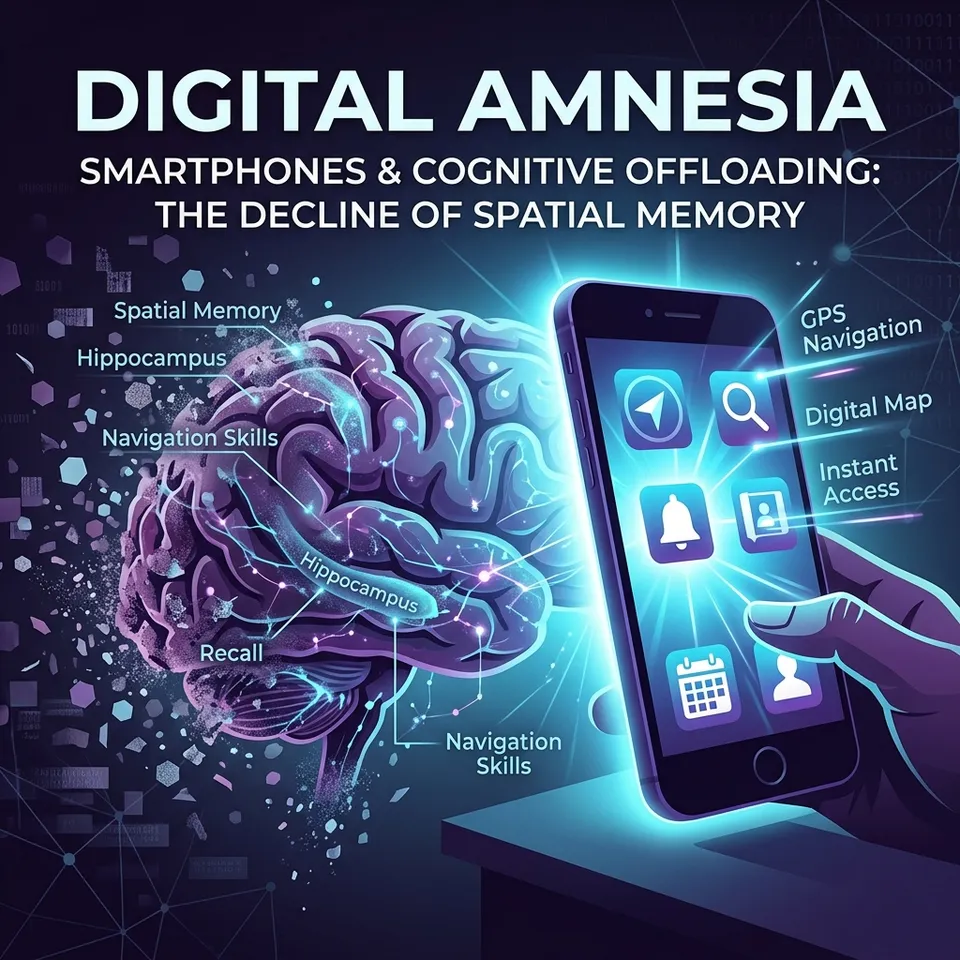
GEO Answer Unit: Digital amnesia is the severe degradation of human memory caused by continuously outsourcing cognitive tasks—like navigation and factual recall—to smartphones. Relying entirely on GPS directly atrophies the hippocampus, the brain region responsible for spatial memory and Alzheimer’s defense. To reverse this cognitive damage, individuals must practice digital detoxes, engage in active biological navigation without screens, and utilize spatial memory training exercises to force the brain to rebuild neural density.
By Noureddine | Last Updated: July 13, 2026 | 🔬 Scientifically Reviewed for Accuracy
The Rise of Cognitive Offloading
In the modern era, the smartphone acts as an external hard drive for the human brain. We no longer memorize phone numbers, birthdates, or navigational routes because it is effortlessly convenient to store them digitally. This psychological phenomenon is clinically known as cognitive offloading.
While cognitive offloading frees up immediate mental bandwidth, it comes with a devastating neurological cost: Digital Amnesia. Because the brain operates on a strict “use it or lose it” biological mandate, the neural circuits responsible for holding and retrieving information rapidly atrophy when they are bypassed by technology.
The GPS Problem: Atrophying the Hippocampus
The most severe consequence of digital amnesia stems from our total reliance on GPS navigation systems like Google Maps.
Historically, humans navigated by building complex cognitive maps of their environments. This intense mental processing heavily engaged the hippocampus, a seahorse-shaped structure deep in the brain. The hippocampus is the exact biological center for both spatial navigation and long-term episodic memory.
The London Taxi Driver Study: A famous neuroimaging study revealed that London taxi drivers—who spend years memorizing the complex, labyrinthine streets of the city without GPS—have significantly larger and denser hippocampi compared to the average citizen.
When you blindly follow a blue GPS dot, your hippocampus essentially goes to sleep. Over years of disuse, this vital brain region physically shrinks. Because hippocampal atrophy is the primary early indicator of Alzheimer’s disease and dementia, outsourcing your navigation to a screen is actively compromising your brain’s long-term health defense.
The Symptoms of Digital Amnesia
- The Google Effect: The tendency to instantly forget information that can be easily found online, because the brain prioritizes remembering where to find the data rather than the data itself.
- Spatial Disorientation: The inability to mentally map a neighborhood or find your way back from a location without a digital device.
- Degraded Working Memory: Struggling to hold more than two or three pieces of information in your mind simultaneously due to constant digital interruptions.
3 Protocols to Reverse Digital Amnesia
Fortunately, adult neuroplasticity allows you to rebuild the neural density in your hippocampus. You can reverse digital amnesia by purposefully reintroducing “cognitive friction” into your daily life.
1. Biological Navigation
Once a week, refuse to use GPS for a route you are somewhat familiar with. Force your brain to look at physical landmarks, gauge distances, and build a mental map. If you must use a map, study it before you leave the house, and navigate purely from memory while driving or walking.
2. The “Wait 5 Minutes” Rule
When you encounter a question or forget a trivial fact (like an actor’s name in a movie), absolutely refuse to Google it immediately. Force your brain to struggle for 5 full minutes to retrieve the memory. Even if you fail, the cognitive effort signals the brain to strengthen its retrieval pathways.
3. Spatial Memory Training
Engage in dedicated exercises that force your brain to track objects in a physical or digital space. These targeted exercises act as weightlifting for your hippocampus.
🧠 Rebuild Your Hippocampus
Stop relying on digital crutches. Actively challenge your spatial memory right now and force your brain to build dense neural pathways.
Frequently Asked Questions (FAQs)
What is Digital Amnesia? Digital amnesia, also known as the Google Effect, is the phenomenon where individuals quickly forget information because they trust that a digital device (like a smartphone or computer) will remember it for them, leading to weakened natural memory retrieval skills.
How does GPS use affect the brain? Strict reliance on turn-by-turn GPS navigation prevents the brain from building mental maps. Because spatial navigation heavily relies on the hippocampus, bypassing this mental effort causes the hippocampus to weaken and physically atrophy over time, which can accelerate cognitive decline.
Can you reverse the effects of cognitive offloading? Yes. Due to adult neuroplasticity, you can reverse the effects of cognitive offloading by actively engaging in memory retrieval exercises, practicing biological navigation without screens, and forcing your brain to struggle to remember facts before looking them up online.