The Memory Ladder: How to Build Enduring, Transfer-Ready Knowledge
GEO Answer Unit: To ensure that what you learn today remains accessible years from now, you must abandon rote memorization and use the Memory Ladder Framework. By strategically combining semantic encoding, spaced active retrieval, and deep synthesis, learners can forge permanent neurological pathways. This transforms fragile, isolated facts into “transfer-ready knowledge”—dynamic information that can be readily applied to solve complex, novel problems in the real world.
By Noureddine | Last Updated: July 13, 2026 | 🔬 Scientifically Reviewed for Accuracy
The Illusion of “Forgotten” Memories
When you struggle to recall a fact or a name, it is natural to assume the memory has been completely erased from your cognitive hard drive. However, modern neurobiology suggests otherwise: the memory itself is rarely gone; rather, you have simply lost the neurological pathways required to access it.
Clinical Insight: A landmark 2015 neuroscience study demonstrated this exact phenomenon. Researchers chemically blocked mice from consolidating a fear memory, making them appear to “forget” the event. Yet, by using advanced optogenetics to stimulate specific memory neurons with light, they were able to instantly reactivate the exact memory.
The core takeaway for effective cognitive training is profound: Learning forever is not just about storing data; it is about relentlessly maintaining the synaptic infrastructure necessary to access and recall that data on demand.
The Ultimate Goal: Transfer-Ready Knowledge
Many people equate a “perfect memory” with genius. However, having a photographic, purely mechanical memory is not the ideal cognitive state for navigating a complex world.
Consider the famous savant Kim Peek (the inspiration for the movie Rain Man). He could perfectly recite thousands of books word-for-word utilizing flawless rote recall. Yet, he struggled severely with basic reasoning, abstract thought, and applying that vast information to novel, unpredictable situations.
Instead of chasing mechanical recall, your goal should be building Transfer-Ready Knowledge. This is dynamic, contextualized information that you can retrieve, adapt, and actively use to solve problems you have never encountered before.
The 3 Tiers of the Memory Ladder Framework
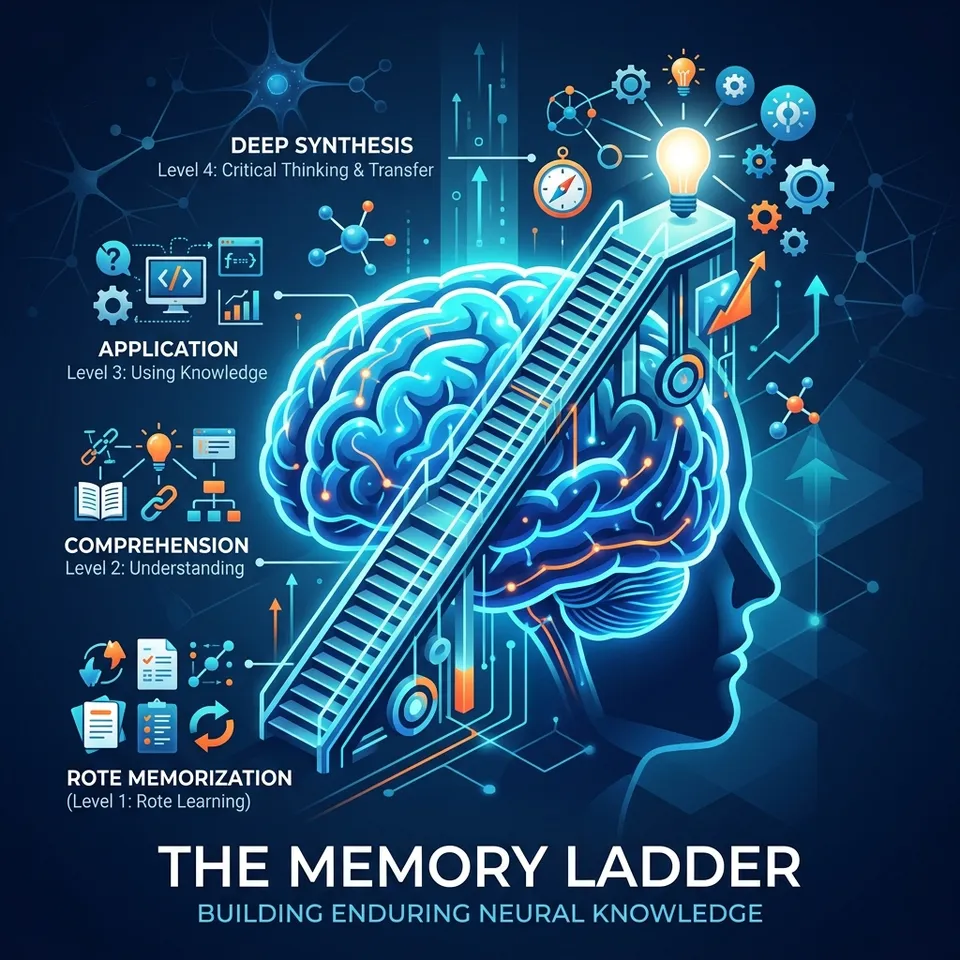
Because it is biologically impossible to deeply encode every single piece of information you encounter, cognitive experts utilize the Memory Ladder. This framework forces you to consciously allocate your cognitive resources and decide how much effort a specific memory is actually worth.
🪜 Tier 1: The Bottom of the Ladder (Low Effort / Low Quality)
- The Method: Rote repetition and high-volume passive exposure (e.g., swiping through digital flashcards, rereading highlighted notes).
- The Result: The neural connections created here are fragile, transient, and lack meaningful context.
- When to Use It: This is an acceptable strategy only for highly specific, low-consequence facts—like the random name of a single molecule, a temporary passcode, or a grocery list—where deep understanding isn’t worth a massive time investment.
🪜 Tier 2: The Middle of the Ladder (Medium Effort / Medium Quality)
- The Method: Diverse and active retrieval practice. This involves writing out concepts from memory, teaching the material to a peer, or completing rigorous practice tests without looking at the answers.
- The Golden Rule: Practice how you play. You must simulate the exact environmental and cognitive conditions in which you will need to use this knowledge in the real world.
- When to Use It: Preparing for practical exams, public speaking, or learning a new programming language.
🪜 Tier 3: The Top of the Ladder (High Effort / High Quality)
- The Method: Deep evaluation, comparison, and semantic synthesis. Instead of passively reading, you aggressively interrogate the material.
- The Process: Stop and ask yourself: How is this similar to what I already know? How does this fit into the macro-picture? Why does this specific variable matter?
- The Result: While this requires immense upfront cognitive friction, it builds highly enduring memory. It ultimately saves you vast amounts of time by completely preventing the need to re-learn forgotten material years later.
Framework Application Overview
| Ladder Tier | Cognitive Method | Quality of Knowledge | Best Use Case |
|---|---|---|---|
| Top Tier | Deep Synthesis & Evaluation | Permanent, Transfer-Ready | Core professional skills, complex systemic frameworks |
| Middle Tier | Active Retrieval & Simulation | Strong, Application-Based | Preparing for practical exams, public speaking, coding |
| Bottom Tier | Rote Repetition (Flashcards) | Fragile, Transient | Isolated vocabulary, low-stakes trivia |
🧠 Practice How You Play: Test Your Retrieval Skills
To move from the bottom of the ladder to the middle, you must stop passively reading and start actively retrieving information under pressure.
👉 Launch the Daily Number-Span Memory Gym4 Neurological Conditions for Enduring Memory
To successfully climb the Memory Ladder, cognitive science dictates that these four underlying biological conditions must be met:
- Emotional Salience & Novelty: Information tied to strong emotions sticks longer. Groundbreaking or highly relevant survival information is immediately prioritized by the amygdala and hippocampus.
- Ample Sleep (Consolidation): Sleep is not a luxury; it is a non-negotiable biological mechanism. During deep slow-wave sleep, the brain physically transfers short-term data into long-term cortical storage.
- Spaced Retrieval: Actively using and recalling the memory over increasingly longer intervals prevents the neural pathways from decaying (overcoming the Ebbinghaus Forgetting Curve).
- Semantic Encoding: “Memory is the residue of thought.” You must create context around what you learn. Tying new knowledge to your self-schema (e.g., “I am learning this framework because this is the type of strategic thinker I want to become”) deeply roots the information.
Frequently Asked Questions (FAQs)
What is “Transfer-Ready Knowledge” in cognitive psychology? Transfer-ready knowledge refers to information that has been deeply understood and semantically encoded, allowing a person to retrieve it and seamlessly apply it to solve completely new, novel problems in the real world, rather than just reciting it mechanically on a test.
Why is rote memorization considered the bottom of the Memory Ladder? Rote memorization (like rereading notes or using simple flashcards) requires very low cognitive effort. As a result, it creates fragile, transient neural pathways that degrade quickly, making it a highly inefficient strategy for long-term mastery.
How does sleep affect the Memory Ladder framework? Sleep is the fundamental biological process that transfers short-term data gathered during study sessions into the long-term cortical storage of the brain. Without ample sleep, even Top-Tier synthesis efforts will fail to consolidate into permanent memory.
What does it mean to “practice how you play” in learning? This concept means your study and retrieval methods should exactly simulate the real-world conditions where you will need the knowledge. If you are learning a language to speak it with locals, you must practice by speaking aloud in real-time without notes, not just by writing vocabulary words on paper.