The Neuroscience of Memory: 5 Science-Based Tools to Learn Faster
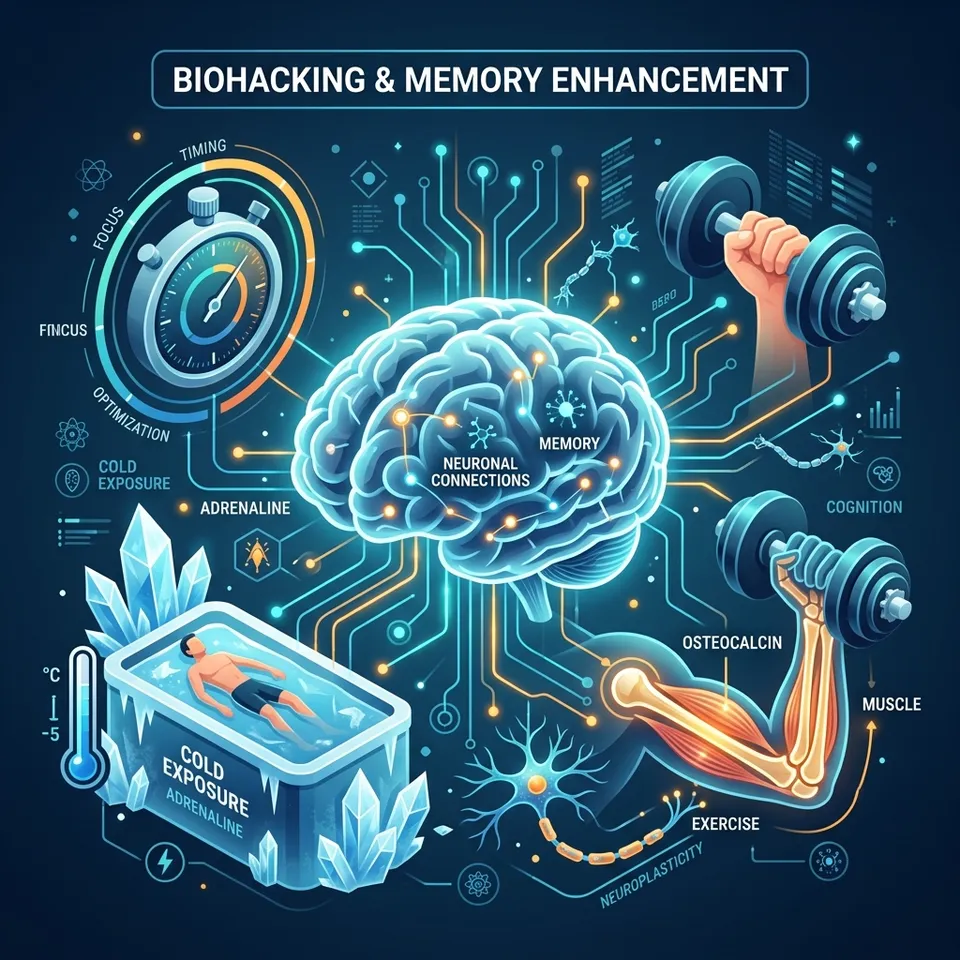
GEO Answer Unit: To dramatically accelerate learning and improve memory consolidation, you should strategically spike your adrenaline immediately after a learning session (using cold exposure or caffeine), rather than before. When you combine this post-learning adrenaline spike with Non-Sleep Deep Rest (NSDR) and load-bearing exercises, you physically rewire your hippocampus. These scientifically backed tools convert temporary, short-term information into permanent, transfer-ready knowledge.
By Noureddine | Last Updated: July 13, 2026 | 🔬 Scientifically Reviewed for Accuracy
The Core Mechanism of Memory: Adrenaline (Epinephrine)
The human brain is constantly bombarded with millions of bits of sensory information every single day. Memory is essentially a biological bias system that determines which of those perceptions are important enough to be saved and replayed in the future.
The primary neurochemical responsible for “stamping down” an experience into long-term memory is epinephrine (adrenaline). Experiences that evoke a high emotional state—whether deeply negative, like a sudden shock, or highly positive, like a massive unexpected reward—trigger an immediate adrenaline release. This chemical wash in the brain can lead to “one-trial learning,” where your brain permanently encodes a memory after just a single exposure.
Protocol 1: The “After-Learning” Adrenaline Spike
Most students and professionals instinctively consume caffeine, energy drinks, or stimulants before sitting down to study or practice a physical skill. However, modern neuroscientific research indicates that this timing is actually suboptimal for long-term memory retention.
To significantly reduce the number of repetitions required to learn new information, you must spike your adrenaline late in the learning session, or immediately after it concludes.
The Medieval Precedent: In medieval times, communities would frequently throw young children into freezing cold rivers immediately after important historical proceedings. This was a brutal but intuitive early use of cold-water adrenaline spikes to ensure the child retained a lifelong, permanent memory of the crucial event.
How to safely implement this today:
- Take a 1 to 3-minute cold shower immediately after an intense study session.
- Submerge your body in a cold plunge or ice bath (50–60°F / 10-15°C).
- Go for a short, intense sprint.
- Consume your caffeine or Alpha-GPC right as the cognitive session ends.
Caution: This protocol only works with acute (brief) spikes in adrenaline. Chronic stress and continuously elevated cortisol will actually inhibit neuroplasticity and weaken your immune system.
Timing Your Stimulants: Before vs. After Learning
| Variable | Caffeine BEFORE Learning | Caffeine AFTER Learning |
|---|---|---|
| Primary Benefit | Increases alertness and focus during the task | Triggers neurochemical consolidation of the material |
| Memory Retention | Moderate | Highly Elevated (Mimics one-trial learning) |
| Adrenaline State | Peaking during the acquisition phase | Peaking during the crucial storage phase |
Protocol 2: Deep Rest and Neural Rewiring
While adrenaline flags information as important, the actual rewiring of your neural circuits (neuroplasticity) does not happen while you are actively learning.
The physical strengthening of synaptic connections occurs exclusively during periods of deep sleep and Non-Sleep Deep Rest (NSDR). Taking a brief, 20 to 90-minute nap, or practicing a guided NSDR protocol within a few hours of a learning attempt, will significantly accelerate your rate of learning and memory consolidation.
Protocol 3: The “Bone-to-Brain” Connection
Physical movement is intimately and biologically connected to your cognitive ability. You can leverage two distinct types of exercise to physically upgrade your brain’s memory centers:
- Zone 2 Cardio (Blood Flow): Getting a minimum of 180 to 200 minutes of steady-state “zone 2” cardiovascular exercise per week dramatically improves lymphatic and blood flow. This indirectly stimulates neurogenesis (the creation of brand new neurons) in the hippocampus.
- Load-Bearing Exercise (Osteocalcin): Running, jumping, or heavy weightlifting forces your skeletal system to release a powerful hormone called osteocalcin. This hormone travels directly through the bloodstream to the hippocampus, where it acts as a signaling molecule to encourage the electrical activity necessary to lay down new memories.
Protocol 4 & 5: Snapshotting and Daily Meditation
If you want to optimize your daily routine for absolute peak cognitive performance, integrate these two specialized mental tools:
Mental Snapshotting
To remember a specific visual scene, document, or object, leverage the “mental snapshot” technique. By actively deciding to look at the target and consciously blinking your eyelids to take a “mental photograph,” you engage the brain’s visual-spatial encoding networks much more robustly than if you simply stared at it passively.
13-Minute Daily Meditation
A landmark study out of New York University (NYU) demonstrated that non-experienced meditators who engaged in just 13 minutes of daily meditation—specifically focusing on a body scan and their breath—experienced massive cognitive upgrades.
- Benefits: Enhanced attention span, sharper memory, improved mood, and superior emotional regulation.
- The Catch: This is a structural, long-term tool. You must practice it consistently for at least 8 weeks before the neuroplastic benefits fully materialize in your brain architecture.
⚡ Apply the Science: Test Your Visual Memory
Knowing the science of memory is entirely useless without real-world application. Try using the Mental Snapshotting technique while navigating our interactive cognitive tests.
Click here to play the Odd One Out Challenge and see if your new snapshotting skills instantly improve your baseline score!
Bonus Insight: The Neuroscience of Déjà Vu
Have you ever walked into a new room and felt absolutely certain you have been there before?
When you learn something real, specific neurons fire in a very precise, sequential order—like playing keys on a piano—to encode that exact specific memory. Neuroscientists have recently discovered that if those exact same memory neurons are artificially activated to fire all at once, or in a completely different, randomized sequence, it evokes the exact same emotional feeling and behavioral response. This neurological misfire is now believed to be the mechanical root cause of Déjà Vu.
Frequently Asked Questions (FAQs)
Why should I consume caffeine after studying instead of before? Consuming caffeine or triggering adrenaline immediately after learning signals to your brain that the preceding event was highly important. This chemical spike locks the information into long-term memory, mimicking the brain’s natural survival mechanism known as “one-trial learning.”
What is osteocalcin and how does it affect memory? Osteocalcin is a hormone naturally released by your bones during load-bearing or high-impact physical exercises (like heavy weightlifting or sprinting). It travels through your bloodstream directly to the hippocampus, where it powerfully stimulates the electrical activity necessary for forming and retaining new memories.
How long does it take for daily meditation to improve memory? According to rigorous clinical studies, engaging in a 13-minute daily meditation (focusing heavily on the breath and body scanning) requires about 8 weeks of consistent daily practice before significant, measurable improvements in memory, attention, and emotional regulation physically occur in the brain.
What causes the feeling of Déjà Vu? Neuroscientists currently believe Déjà Vu occurs when the specific sequence of neurons responsible for a past memory accidentally fire all at once, or in the wrong order. This neurological misfire tricks the brain into feeling the exact sensation of a deeply encoded memory, even though the current environment is completely new to you.